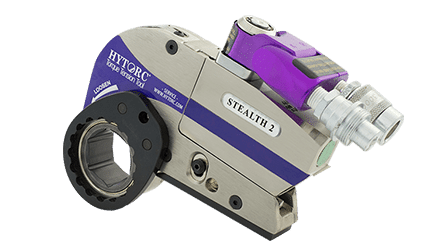
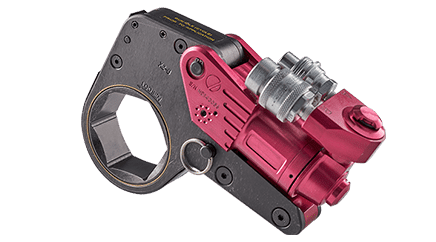
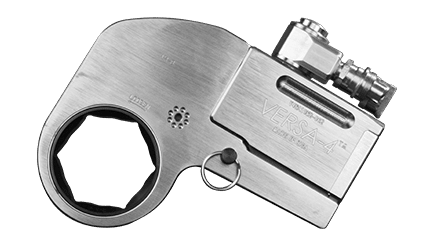
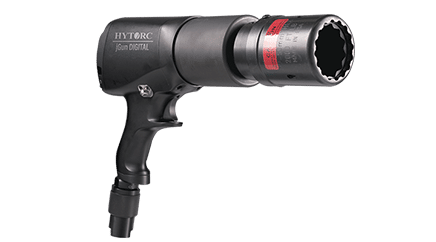
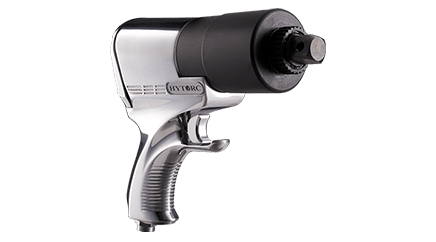
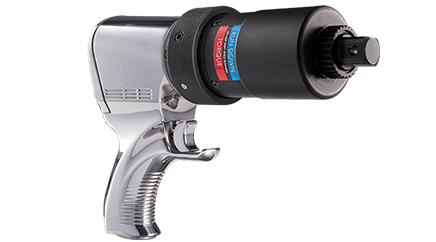
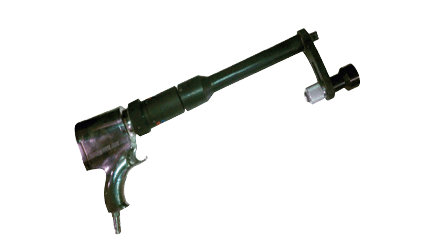
The HYTORC Washer is an accessory that greatly improves torque tightening operations in the three areas of safety, quality and speed by allowing tightening without a reaction arm.
A HYTORC Washer version is available from Backup to retain the opposite nut without a wrench.
The main objective of these HYTORC Reaction Washers is to eliminate the need for a reaction arm in torque tightening operations with either hydraulic wrenches or torque screwdrivers.
The reaction arm, which is essential in conventional torque and release applications, has several disadvantages that can be avoided.
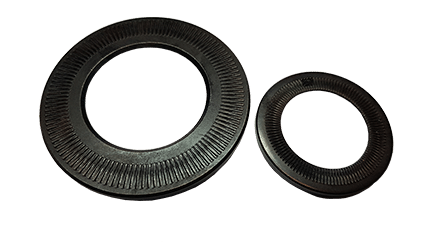
Like a conventional flat washer, the reaction washer offers a precision machined, smooth, hard surface that limits friction from the nut or screw head while its other side is ribbed to grip into the material and contain the reaction back force.
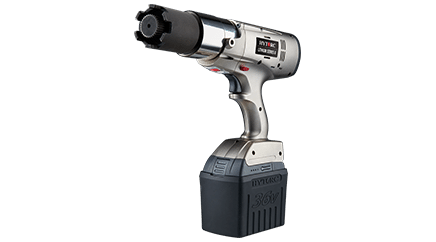
These lock washers are equivalent in thickness to conventional washers and replace them without having to order longer screws for deployment at no additional cost. HYTORC WASHER reaction washers can be used with both pneumatic and battery-powered screwdrivers, and of course with hydraulic wrenches and wrenches.
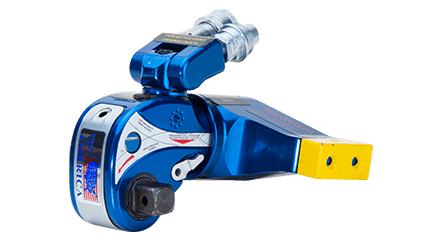
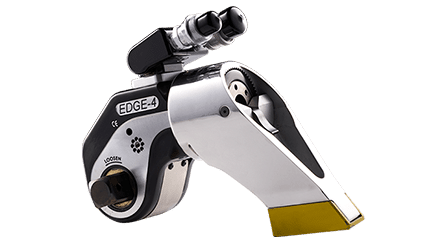
On screwdrivers and square wrenches, simply replace the reaction arm and socket with a driver bell and on eye wrenches add a reaction side plate.
The major risk of injury when torqueing with a torque tool is due to the reaction arm or heel.
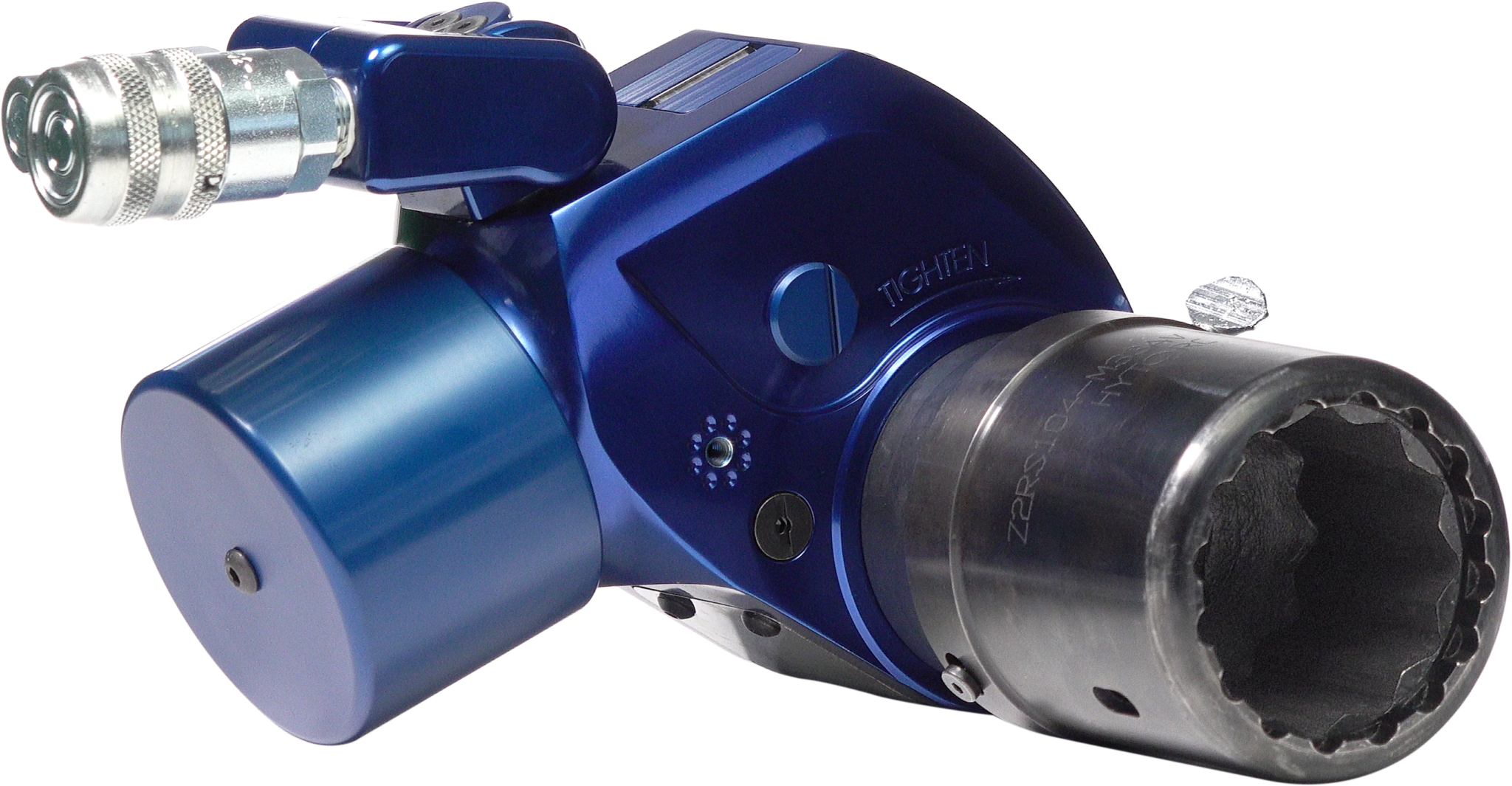
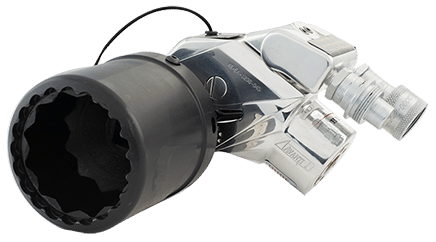
The Hytorc Washer reaction washer uses a bell (driver) which is composed of 2 elements: a classic bushing on the inside and an external bell which has a chiselled impression at its base which takes the external shape of the steel washer. The bell therefore rests on the contour of the washer and holds the frame of the wrench or screwdriver by the coaxial grooves.
With the clamping tool held in place, it can develop its torque as if its reaction arm were in support. The advantage is that there is no risk of getting stuck between the reaction arm and its fulcrum.
The reaction arm of conventional torque tools is a moving part that prevents the screwdriver or wrench from rotating around the bolt when it is operated. It is preferable that the reaction arm or the reaction heel for eye wrenches be supported before starting the machine, otherwise the operator risks being injured by pinching or crushing if his hand is between the arm and a fixed part, as the force involved at the support point is considerable.
For a tool that develops 1000 N.m for example, this effort is of the order of 1Tonne so the danger for fingers and hands is serious. And the use of HYTORC reaction washers increases the safety of the operator by completely cancelling this risk.
Torque tightening with conventional tools has disadvantages in terms of tightening quality which are mainly due to the reaction arm or heel.
Because of the remote reaction support, thetightening operation presses the screw or threaded rod against the edge of its through hole and introduces a shear stress into the bolt.
By concentrating the forces in the axis of the bolt thanks to the reaction which is taken on the whole contour of the washer, this transverse stress is eliminated thanks to a homogeneous effort around the nut which increases the precision of tightening, decreases the wear of the threads and the bearing surfaces.
With the use of HYTORC WASHER reaction washers the sealing of pressure vessels is better controlled and there is a reduction of the variation of the bolt load on the flange. Tightenings close to the elastic limit are less likely to exceed it.
When you use a HYTORC WASHER on a bolted assembly, the bolting process is intuitive, so you don’t have to worry about how to orient the hydraulic wrench or torque wrench so that the reaction arm is supported.
We place the tightening tool directly on the bolt as it is most convenient for us to do so knowing that the chiseled shape of the bell will quickly find a position on the corrugated contour of the metal washer to start tightening or loosening.
The tool’s footprint is smaller and more balanced than a conventional reaction arm, so operator productivity is enhanced when moving quickly from one bolt to another.